



Why LEEWS?
(Remarks from approx our 32nd year)How (and Why) LEEWS Differs From (and Far Surpasses) All Other Exam Writing / Preparation Study Aids
| NOTE: This page, similar to others, is superceded by Gaming Emperor Law School(GELS). In a nutshell, no other aids (none!) address the fundamental reason law students struggle with exams – failure of law school (case method) instruction to transition academic thinkers/learners (all entering students) to a reasonable facsimile of (practicing) lawyer thinkers/learners. They don’t recognize the problem. They merely recycle “IRAC” and “tips” that are but minimally helpful. (E.g., “read questions [sic*] carefully;” “support conclusions;” “plan your response.”) Beyond the equally ineffective expedient of “book briefing,” none offers an alternative to cumbersome, ineffective conventional case briefing. (See in depth GELS discussion referenced below.) None build upon the unique insights that have resulted in the proven effective science of preparation and exam taking LEEWS offers. *Universally, law professors refer alike to essay exercises (fact scenarios called “hypotheticals”) and subsequent questions/instructions as “questions.” Such imprecision typifies the difference between academic thinking and the more rigorous (practicing) lawyer thinking LEEWS inculcates. (See, e.g., GELS, Section 3: Confusion, intimidation, case method instruction lay a foundation for mediocre exam performance in Emperor Law School, Chapter 2 – Conventional case brief; the (many) problems with it; Chapter 3 – LEEWS 2-4 line case brief; more understanding, far fewer class notes; Chapter 4 – Problems with case method instruction. Also Section 5: Fundamentals en route to a solution, Chapter 3 – Why case method cannot impart lawyerlike thinking; a path to improvement and advantage; Chapter 4 – The conventional wisdom (CW) of law exam writing and preparation (It isn’t enough!); and Chapter 8 – Omnipresent “IRAC” (Where this [mere] formula fits into the picture).) |
- Introduction
- The ineffectiveness of conventional exam writing wisdom
- “IRAC” is not a “system”
- How LEEWS differs — a snapshot
- Competitor Comparisons —
- Introduction
- LEEWS vs. Study Aids in General (programs offered by professors, upperclassmen, etc.);
- LEEWS vs. free, 45-minutes BAR-BRI-sponsored exam writing session (including Eight Secrets to Top Exam Performance);
- LEEWS vs. book, Getting to Maybe;
- LEEWS vs. Fleming’s 2-day workshop;
- LEEWS vs. Law Preview / BAR-BRI (1-week, 2-week simulated law school programs);
- More on How LEEWS is Different and LEEWS Content
- Footnotes
Introduction
I sat wondering why this was never taught first semester in law school. When law professors teach you to write exams they basically say, “Here are some engine parts. Go figure out how to put the engine together.” But LEEWS says, “Here is what each engine part consists of and how it works, and this is how you put it together.” Thank you LEEWS! I truly feel I have an advantage over my classmates.
— Maria Farias, Whittier (CA) ’03| Students query, “Will I write lots of [practice] exams at LEEWS?” No. LEEWS is all about reducing exam exercises (normally “hypothetical” fact patterns) in disciplined, systematic fashion to a series of manageble components. The components correspond to “issues” a professor wants discussed. Analysis of each will be presented in roughly a paragraph. The task becomes not “How do I write the exam?,” a vague, unwieldy, unhelpful concept, but “How do I identify and handle the components of each exam hypothetical?” The sum of each component handled effectively is an exam essay handled effectively. The idea is that every exam essay exercise becomes a predictable and maneageble – a series of components (issues!), a series of concise, impressive paragraphs of analysis that will impress and garner rare law school A’s. Therefore, what is learned and practiced at LEEWS is a disciplined, innovative, 3-step, true SYSTEM for breaking down any and all fact patterns to reveal components, how to analyze components “as a lawyer,” and presentation of analysis in concise paragraphs (roughly one per issue). You also learn how to do the aforementioned 2-4 line case brief, how to take less than a page of notes per class hour, how to construct a 30-50 page course outline, and much much more. You learn — finally! – how to be a lawyer and how to express yourself as such on an exam. Since most law students, even at Harvard, are clueless about HOW to systematically identify issues in fact patterns, HOW to analyze “as a lawyer,” HOW to present analysis concisely, and HOW to prepare for these tasks, the exams of LEEWS grads of even average ability stand out, impress, and routinely earn rare “A” grades. |
The ineffectiveness of conventional exam writing wisdom
The conventional wisdom of law exam writing/preparation has been around for decades and has never been especially effective for all but a small minority of law students. The vast majority of law students — over 80 percent, even at Harvard –, despite intelligence and hard work, cannot manage a single A first term. Not one! Despite grade inflation in recent years that has made B and B+ the norm at many top law schools, even at Harvard where most students have high LSAT scores and 4.0 college gpa’s, often fewer than 10 percent of the grades in a class are A’s. Never more than 15 percent. LEEWS introduces unique insights and a system of preparing for and taking ANY law essay exam that goes far beyond conventional IRAC-centered wisdom. Given the cluelessness of the great majority of even the most intelligent and diligent law students, LEEWS enables students of even average ability to write exams that stand apart and compete for rare “A” grades.“IRAC” is not a “system”
“IRAC” (Issue, Rule, Analysis, Conclusion) is central to the exam-writing advice offered by law professors and most other sources. “Follow IRAC,” “IRAC the exam,” they will say. IRAC is said to be a “system,” “all you need to know.” But IRAC is merely a format for ordering presentation of the discussion of an issue. Some professors and law schools, largely to prep their students for the bar exam (where normally a statement of conclusion is wanted first), rearrange IRAC to CRAC. It is all the same and not enough. Indeed, IRAC misleads. It suggests that the conclusion is important. The conclusion is somewhat important on bar exams, but rarely on a law school exam. Just as learned jurists can arrive at different conclusions following closely reasoned argument, so well-reasoned analysis can suggest different conclusions. To emphacize that it is the analysis they are interested in, more enlightened professors will instruct, “I don’t want to see a conclusion.” The IRAC acronym indicates WHAT is wanted, but falls far short on HOW. For example, given that a statement of issue and rule is wanted, HOW do you find all issues in a hodgepodge of facts? (For that matter, what IS an “issue?”) HOW do you “analyze as a lawyer?” HOW do you present analysis concisely on paper? LEEWS goes beyond IRAC to answer these questions, and much more. For example, LEEWS instructs an innovative format for presenting analysis of “issues” in concise paragraphs that takes the WHAT of “IRAC” to the HOW of implementing IRAC. If, as most new law students, you know nothing about writing law exams, IRAC seems an important insight — a revelation. However, it merely scratches the surface of the problem. It is hardly a system. back to topHow LEEWS differs — a snapshot
LEEWS differs markedly from all other study aids in several important respects. First, only LEEWS has diagnosed why and how law schools across the board fail in their essential mission — training lawyers, and how this failing translates into a disconnect between classroom and exam performance. Perhaps because they lack this insight, perhaps because they pander, no other study aid questions the cornerstone of law school instruction – the case method and conventional case briefing. “1Ls” (first term law students) busy themselves briefing cases and taking endless notes in class (as they have been instructed), and fewer than 20 percent manage a single A, even at Harvard (!!). Most law students question this colossal and largely fruitless expenditure of time and effort — but not until second term.| LEEWS alone teaches students to get far more out of class and cases while briefing in only 2-4 lines (!!) and taking less than a page of notes per class hour. Law professors scoff at such a notion. They point to this assertion as a reason for skepticism. Both they and our competitors have no idea how this is possible. But there is no mystery. If you knew how to “think as a lawyer” (which most law students learn only after they begin practicing law); if you knew how to think about not only how the law was applied in a given case, but you were further in the habit of thinking about its application in new situations (making up your own hypotheticals!), there would be more useful thinking and retention in your head (relevant law and an understanding of how to use it) and less busywork scribbling on paper. |
“The good news in law school is that you don’t have to write such an excellent exam. The good news is that most law students, even at Harvard, write lousy exams. In comparison, your reasonably competent exam will impress and earn rare ‘A’ grades.”
back to topCompetitor Comparisons Introduction
Naturally, we familiarize ourselves with what the competition is up to. (Actually, in recent years, as it has become apparent that others are truly persistent in recycling the same old, same old IRAC + helpful hints as “the only system,” we have paid less attention.) In this section we compare LEEWS with the following competitor programs and aids — 1) LEEWS vs. Study Aids in General, including formal and informal advice sessions given by law professors, upperclassmen, and law schools, books, etc.; 2) LEEWS vs. Free, Hour-long, BAR-BRI-sponsored Exam Writing Session (featuring USC professor Charles Whitebread and his booklet, Eight Secrets to Top Exam Performance); 3) LEEWS vs. The Book, Getting to Maybe; 4) LEEWS vs. Flemings (Fundamentals of Law) two-day exam-writing workshop; and 5) LEEWS vs. One and Two-week Simulated Law School Pre-law Programs (e.g., BAR-BRI/NILE and Law Preview). And also the Law Preview day-long, term-time exam writing program. We present a final segment (#6) entitled More on How LEEWS is Different and Its Content. We hope, thereby, to provide in depth insight into what LEEWS entails and accomplishes, how LEEWS is different and more effective, and persuade you that THERE IS SIMPLY NO ALTERNATIVE TO LEEWS — NOT EVEN CLOSE! (For a detailed listing of the contents of a LEEWS program, click to see the track titles on the back of the vinyl binder for our audio CD programclick to see the track titles on the back of the vinyl binder for our audio CD program) This is what Wentworth Miller, LEEWS founder and instructor of most live programs, says about other offerings: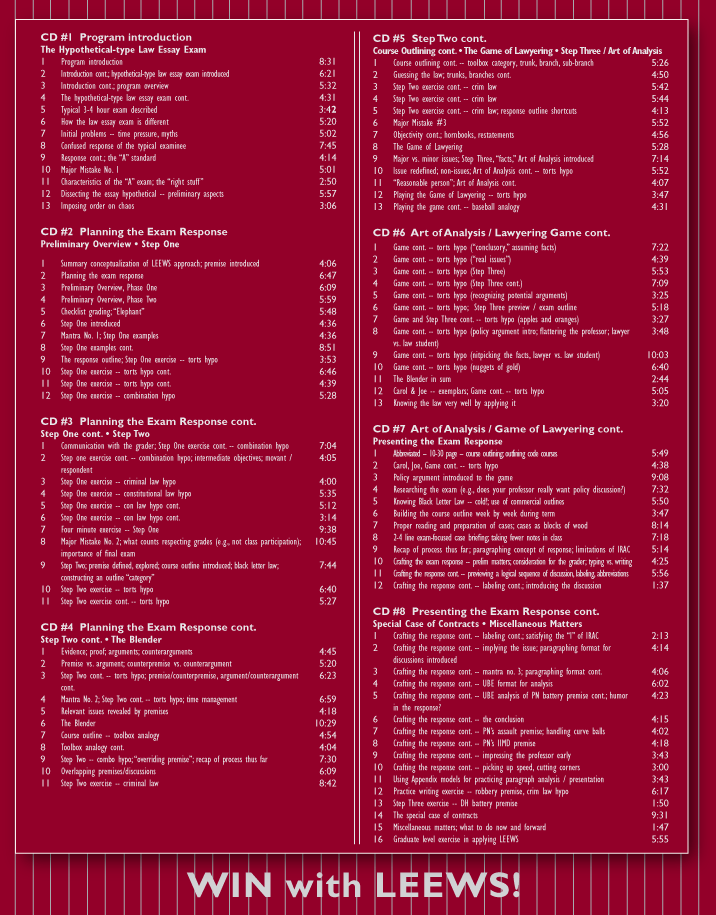
My program simply does a much better job than other instructional aids, including law school itself, providing students with an efficient, effective approach to day-to-day, week-to-week study, providing a disciplined, proven effective system for breaking down and handling ANY law essay exam well, and, perhaps most important, showing what, exactly, lawyers do, how they think and analyze (apply law to facts), and how to reflect this in every task posed not just in law school, but as a summer law associate, and throughout lawyering life.
— Wentworth Miller, founder/instructor, LEEWS
back to top1) LEEWS vs. Study Aids in General (including programs offered by law professors, upperclassmen, law schools)
The date is 10/29/13. I (Wentworth Miller, LEEWS Founder/instructor) am returning to this segment of my (yes, extensive) website for the first time in nearly ten years (!!). The reason for the long hiatus is that nothing changes much in the law school firmament. And, yes, the information below remains current. (I’ve changed “20+ years” to “30+ years.”) What prompted this return was searching “law exam writing,” and seeing an offering from an outfit called “ehow.” It’s an online exam writing instruction site. I wondered, “Hmm. Anything new?” Nada! Here’s the first thing they say about addressing an essay exam: “Read over your fact pattern carefully and preferably twice.” No, no, no! Precisely this plunge into the crazy quilt morass of facts to “read carefully” immediately confuses and intimidates. Yet all other study aids, all law professors (unless they are LEEWS grads) give this advice. (Well. Some say, “First read the question.” Then it’s “Read the facts.”) LEEWS alone understands the folly of willy-nilly reading facts. We understand that complex fact patterns must be approached piecemeal, with limited objectives. Otherwise, one gets overwhelmed. Eventually all facts will be read (much more closely than any but practicing lawyers can imagine). They will be digested. They will be paired with relevant legal principles to resolve issues that lurk within them. However, the process will be systematic, disciplined, comfortingly predictable. You, not the fact pattern, are in charge. No one else believes a science of writing and preparing for challenging law essay exams exists. Thus, no one else has sought such a science. All other advice remains IRAC and the same ‘ol, same ‘ol hints and tidbits that has never enabled mastery. LEEWS is the science others can’t even imagine. Take advantage of it! During the last 30+ years law school study and exam writing aids have proliferated. There are numerous books, law professor lecture series, CD roms, flashcards, audio programs, and even one and two-week prelaw simulated law school programs featuring law professors as instructors. In law school itself professors, upperclassmen, the student bar association, and other campus organizations have long conducted how-to-study and how-to-write-exams sessions varying from a single class period given over to the subject, to more formal programs meeting over the course of several weeks. Such aids/programs offer instruction in whole or part on how to read and brief cases, how to study, substantive law [the assumption, not necessarily incorrect, being that you can’t learn the law in class and from your texts], how to outline courses for exams, and how to write law school exams (including “issue” identification, analysis, and presentation), especially the curious and typical so-called “essay hypothetical” — so-called, because it consists of made-up stories or fact patterns (“hypotheticals” or “hypos”) that present problems needing lawyerly resolution. The fundamental LEEWS difference and advantage is that it addresses all of these areas (!!) more innovatively, more thoroughly, and more effectively than any and all such aids/programs combined. Moreover, LEEWS offers both a money back guarantee of results and a free trial of both live and audio program. For example, once you learn how to analyze “as a lawyer,” which LEEWS instructs better than anyone else (including law professors!), you’ll know how to learn and know substantive law from casebooks (supplemented by [used] commercial outlines). You’ll begin, typically, to brief cases in 2-4 lines, take less than a page of notes per class hour, and construct course outlines of no more than 20-50 pages (!!). (Versus the typical 1/2 – 1 page brief, 3-4 pages of notes per class hour, and 100-150 page course outlines generated by most law students — all of which proves ineffective on exams.) (For more on the content of a LEEWS program see the Program Content section.) In addition, law schools themselves sometimes offer study and exam writing skills programs. Catholic University in Washington, DC, for instance, invited in the long-ago discredited Professor Narissa Skillman to conduct her ranting (so we’re told) program on how to prepare for and write law exams. UWLA (Univ. of West Los Angeles) and other lesser California law schools have invited in the Fleming program. John Marshall in Chicago has invited in the Law Preview program. LEEWS does not seek the endorsement of law schools or law professors. LEEWS has been invited into law schools, more often by student groups than administration. However, in that LEEWS challenges the entire instructional orthodoxy of law schools and contradicts much of what law schools and law professors instruct — e.g., 2-4 line case briefing versus the standard 1/2 -page long procedure-facts-issue-rule-holding-rationale standard briefing instruction, an invitation by law school administration is seldom repeated. This in spite of students loving the program.If an exam writing program is conducted by or approved of by a law school, you may be sure that it does not challenge such ineffective, time-wasting law school staples as conventional case briefing. You may therefore be sure that it breaks no important new ground in solving the problem of how to prepare for and write law essay exams.
In recent years prior to the start of the school year, more and more law schools have offered orientation programs intended to test and/or buttress the writing and analytic skills of provisionally admitted students, or marginal admittees whose skills are thought to need sharpening. Regularly admitted students may avail themselves of such programs for a fee. [E.g., some years ago Pace University Law School (Westchester County outside of NYC) started such a program — a simulation of law school, ending with a mini exam —, and charged regularly admitted students $700 or so to attend.] “Why?” you may wonder, would a law school admit students whose abilities may not be up to par? Answer — at today’s tuition rates it is good business to fill classrooms. Just get those students up to speed. Naturally, the existence of so many programs and aids, all purporting to be “just what any law student needs for success,” creates confusion, or possibly a false sense of security. A professor says, “I’ll tell you everything you need to know about my exam.” Why would a newbie law student doubt this? Meanwhile, the SBA (campus chapter student bar association chapter) conducts exam-writing / study skills sessions. BAR-BRI (giant bar exam instruction company) conducts a free 45 minute program at which you get a booklet on how to study and write exams (see #2 below). Surely this is enough. Surely you now know all there is to know and all you need to know. For example, you know “IRAC.” Professors and upperclassmen have said, “IRAC is all you need to know.” Nope! Not even close! Should you peruse other sections of this website, especially letters in the Results section, Reactions of Students, the Table of Contents of the LEEWS Primer, the track labels on the back vinyl cover of LEEWS’ CD audio program (at Regis/Order/Cost) and the review of (merely helpful) standard advice offered by professors and others, you’ll perceive that what LEEWS offers beyond the instruction of others is more insight into the nature of legal problem solving, a true system for pulling apart the essay hypothetical to reveal relevant issues, and better instruction in lawyering skills, particularly analysis and presentation. 1 Law professors and others simply haven’t thought about the problem of preparing for and writing law exams so long or closely as Wentworth Miller. (The likely reason is that they don’t believe a SCIENCE of how to prepare and write law exams exists. If such did exist — and IT DOES!! — it would diminish the idea that writing “A” law exams requires an innate lawyering aptitude — the “Right Stuff” –, which is highly the flattering to the egos of professors and students who have done well.) They lack the fresh — revolutionary, really — insights of the LEEWS approach. They don’t come close to the hands-on, practical, “HOW TO” instruction LEEWS offers. back to top2) LEEWS vs. Free, 45-minute BAR-BRI-sponsored Exam Writing Session
(featuring USC Professor Charles Whitebread and his booklet — Eight Secrets to Top Exam Performance)– Earl B. Christy, U. Florida ‘99
Whitebread came to our school. … Heh, heh, heh. He was as plain as his name. Thanks for the meat and potatoes.– Paul, Benjamin Cardozo (NYC) ’05
3) LEEWS vs. The Book, Getting to Maybe (GTM)
A number of years ago students began suggesting to us that they liked the book, Getting to Maybe (GTM), and that we should look into it. In more recent years we only occasionally hear mention of it. GTM was published in 1999 by law professors from U Miami and U. Connecticut — Richard Fischl and Jeremy Paul — who had known one another while students at Harvard Law School. Naturally, LEEWS founder and instructor, Wentworth Miller, himself a graduate of the higher ranking Yale Law School, doubted that anyone from Harvard could have much of significance to contribute. Seriously, any time a law professor recognizes that law school exams are problematic and help is needed, and deigns to descend from his/her lofty pedestal to wrestle with the problem, we think it is a very positive thing. So we looked into GTM, which has become a very popular purchase and, some contend, a substitute for LEEWS. Trust us — it is not. Here’s what the authoritative book, Planet Law School II (2003), has to say about GTM: “After years of further reflection [following an initial favorable review when GTM came out] … what [GTM’s elaborate system of ‘forks’ — see below] all amount to is a method for issue-spotting. [Original emphasis.] When it comes to conducting a lawyerlike analysis, the authors really only say ‘just add reasons’ (and they use that exact phrase). … Well, gee. That doesn’t help you much. … So, ultimately, I [pseudonymous author, Atticus Falcon] am sorry to say, Getting to Maybe is not anywhere near as good as I’d thought in my initial burst of enthusiasm for it. Its main virtue is in the title itself. … I’m now embarrassed to say that, at bottom, GTM is misleading. Its style is great. Its substance is lacking. … you should give it your lowest priority as an aid to examsmanship. In fact, spending time on its overly elaborate system of merely finding forks will very easily get you ‘forked’ on your exams.” (pp. 171-173) First off, a preview on our take on the substance of what GTM offers — possibly some useful advice at the more esoteric (read “policy emphasis”) end of the exam writing process, but little in the way of new, practical, nuts and bolts exam writing instruction. GTM doesn’t come close to offering a system. Not any more than the standard advice we offer here free (which some would insist is a “system”). Indeed, GTM continually refers to its own advice as “test-taking tips.” We found just a few new takes on the same old, same old, which, to a prelaw who knows virtually nothing, would seem very deep indeed. “And I only have to buy the book!” The key problem, even assuming GTM offered anything new, is that it is merely a book. We learned long ago that it is awfully hard to convey something so complex as how to write law exams in a book, even a book with explicit diagrams. And GTM offers no diagrams, just text. For example, how hard is it to learn to do something so elementary as, say, assembling a bicycle, or installing a doorknob from a book? Imagine then how unlikely it is that you can learn to do something so complex as preparing for and taking a law exam from a book. For example, The Exam Writing Primer that accompanies both our live and audio program sets forth our approach as well as one might imagine a sixth edition can. Nevertheless, students can’t seem to grasp the approach overall from the book alone. They are aided by the book in the sense of useful insights and techniques here and there. However, students seem to need to be led, step by step, through the many facets of the approach by someone knowledgeable of the big picture. Therefore, until professors Fischl and Paul take to the road with a program of hands-on instruction, and test and polish and perfect that instruction with generations of law students, even assuming they have useful new insights and techniques to convey, their book alone must fall at best in the broad category of merely helpful advice. As for the substance of Getting to Maybe, the authors correctly point out that “knowing the law is important, but not enough,” and “knowing the answer” is not what doing well on law exams is all about. They also correctly point out that “legal educators [that means law professors!] don’t do a very good job of teaching exam skills, at least not directly” (p.4). Reinforcement of this controversial proposition may be the most important contribution of GTM. However the authors quickly move to their main theme — what really counts in writing excellent exams is analysis, arguing on both sides, exploring “ambiguities” and “forks” lurking in fact patterns (which they, like most professors and others, misleadingly call “questions.” See discussion of BAR-BRI/Whitebread below.). “The real trick,” the authors assert, “is Getting to Maybe” (p.xiii). GTM goes on and on with the theme of searching out and exploiting and reveling in the ambiguity hidden in exam “questions” [sic] as being the key to doing well. Unfortunately,while clearly pleased with themselves for unearthing this seeming key to exam success, the authors never do an adequate job describing, much less instructing, HOW, EXACTLY, one goes about performing such analysis. They wax ad nauseum about the kinds of forks, i.e., ambiguities, one might encounter on an exam — e.g., “twin forks,” “linked forks,” “reciprocal forks,” “concurrent forks,” “proliferating forks,” “hidden forks,” etc. (pp.87-102). They tell you “argue both sides” (of “issues,” which are loosely and confusing defined as “meaning different things in different contexts,” but generally occurring where one finds “exam forks” [p.21]). But when it comes down to HOW, EXACTLY, to perform the desired balanced analysis, GTM reverts to the disappointing generalities that law professors in general retreat behind. They talk about “argument construction,” arguments being “analysis that attempts to persuade” (original emphasis). They say “just add reasons,” then “a concrete example may help you see vividly the difference between mere analysis and argument” (p.135). In other words, they know good analysis when they see it, and if you look at enough good and bad analysis, and further consider minority as well as majority views of legal rules, and pay attention to policy aspects, and further pay especial attention when your professor introduces ambiguities in class, …. Well, what is it that professors always say to students? — “You’ll get it.” “It will click for you.” What particularly disturbed us is the examples of “excellent answers” offered by GTM. Yes, good points and insightful arguments were made, eventually, and here and there. However, these answers rambled far too long. They lacked a structure that one could point to and say, “here, use this on your next response.” They even lacked adequate labels. As for the idea that by looking at lots of responses and attempting to pick out “ambiguities” and “forks” (of all sorts), one can learn to get good at issue identification [That’s right! That’s their “system” for spotting issues.] and analysis, … Well, good luck. Curiously, GTM seems to offer a nod to LEEWS. On p.126 they note that “it’s the conflict between parties … that creates all the forks in the first place. … Paying special attention to the parties and the nature of their conflicts will thus almost always help get you started on issue or ‘fork’ identification. We recommend thinking through your exam problems from the perspective of each party. If the plaintiff says this about the law, how will the defendant respond? If the defendant characterizes the facts this way, how will the plaintiff characterize them? This will get you into the right frame of mind for aggressively identifying and analyzing the relevant issues.” LEEWS grads will immediately recognize elements of the LEEWS issue identification scheme here, if incomplete. However, GTM offers no more acknowledgment to LEEWS than it does to The Wizard of Oz, whose images it exploits on the cover and here and there. (A lawsuit in the making? That’s how lawyers, not law professors, think.) In sum, GTM makes the important point that analysis is key, and that students should go beyond mere black letter result-oriented analysis to exalt exploration of differing points of view as an end in and of itself. It describes WHAT is wanted, but doesn’t come close to adequately showing students HOW to get to this “maybe.” As noted earlier, given the zero knowledge of exam writing advice that prelaws and new 1Ls bring to the table, and the zero advice professors offer early on, GTM will seem a cornucopia of useful advice. The 22 “tips” offered at the end (pp.249-265), while nothing new (See Standard Advice — Free!), are a useful compilation. Even better is the Q and A of “frequently asked questions” (pp.267-285). The student in effect gets to talk to professors about such things as “should I cite cases?” (“both yes and no”), “should I type?” (“generally helps, but could backfire”), etc. Although the authors beat up on IRAC (see Standard Advice — Free!), GTM is NOT against IRAC, as Atticus Falcon of Planet Law School reknown contends. They, as LEEWS, think IRAC is a useful start, but simply doesn’t go far enough, especially respecting the analysis they want. In sum, we think GTM is a useful but hardly essential addition, if one is compiling a library of study aids. If you pick it up before law school or early in law school, it will likely confuse and overwhelm more than help. It is certainly not an adequate blueprint of EXACTLY WHAT TO DO, and is nothing approaching the system LEEWS offers. However, later in law school, or after LEEWS, GTM won’t hurt. It may tweak a few new avenues of ambiguity to think about. back to top4) LEEWS vs. Fleming’s (Fundamentals) Two-day Exam Writing Workshop
— Nicole Hudspeth, U. San Diego ’03
I’ve now done both Flemings and LEEWS. LEEWS is by far superior. I have some learning disabilities, and LEEWS took the fear and mystery out of briefing cases, course outlining, exam outlining, and simplified my writing, I believe LEEWS may save my career. Thank you, Wentworth.— Norman A. Boatman (as a 2L), Lincoln University ‘02
Clearly, Fleming’s helped this person. However, it is likely, given her energy level and dedication to practice, etc., she would have done just as well had she learned IRAC and the standard exam writing wisdom elsewhere (and thereby saved over $200).
back to topThe LEEWS difference (incl. a disagreement w/ PLS author “Atticus Falcon”)
We at LEEWS have never insisted that everyone must take our program to succeed in law school. We have always recognized that a small group of students, perhaps 5-7 percent in any class, unpredicted by LSAT score and college gpa, is going to consistently emerge at the top of the grading curve. Some simply have a knack for the nitpicking “lawyerlike” analysis that impresses and earns A’s. Some go to Herculean lengths. A student comes to mind who credited his success to “writing fifty practice exams.” Another swore by carefully constructed course outlines that each exceeded 200 pages. What we would like to emphacize is that given the confusion and ignorance of the vast majority of law students at the end of a semester of instruction, even at Harvard (!!), ONE NEED ONLY SHOW A PROFESSOR A LAWYER VERSED IN THE PROFESSOR’S SUBJECT AREA COMING OFF THE EXAM PAGE TO BE AMONG THE FEW AT THE TOP OF THE CURVE WHO ARE AWARDED A’s. LEEWS grads don’t need Aspen series, canned briefs, or course outlines prepared by others. Yes, tendencies, likes/dislikes of professors should be taken note of — we advise our students to do a lexis-nexis search for any articles written by their professors in the past 2-3 years and read them. However, we are confident that our system for identifying ALL issues in ANY essay, our format for presenting analysis in concise paragraphs (roughly one per issue), and especially our matchless instruction on how to analyze “as a lawyer'” (over 2 hours in our program, and the key to learning the law properly, 2-4 line case briefing, 30-50 page course outlines, etc.), will enable even a law student of average ability to outshine classmates on exams and earn A’s. Our grads work hard. They must to learn the law properly and construct outlines for effectively implementing the LEEWS’ issue identification approach. They also practice writing and analyzing. But never entire exams. Rather, a paragraphed analysis of an issue here and there. Perhaps 3 or 4 per week. 15-30 minutes exercises. And they can compare these with the model among tens of paragraphs of analysis in the back of the LEEWS Primer, and thereby, as their response gets closer to the model in concision and insight, better and better at analysis and presentation, and more and more confident. The game of lawyering understood, the necessary skills in hand, LEEWS, casebook, and commercial outline are the only tools needed(!!). This diametrically contradicts the view of Atticus Falcon, pseudonymous author of Planet Law School, respecting what is required, which has occasioned the contretemps that will now be discussed. A contretemps with the author of Planet Law School The Fleming’s program was described as “possibly as good as LEEWS” in the first edition of Planet Law School (1998). However, “Atticus Falcon,” the pseudonymous author of PLS, admitted that his knowledge of Fleming was hearsay. Five years later in Planet Law School II (2003), presumably after further research, there is no mention of Fleming’s — nothing! Meantime LEEWS, which Falcon attended in person at least twice, is praised to the skies as “a Godsend.” Wentworth Miller is likened to Moses bringing the truth down from the mountaintop. Falcon laments that he did not think of the LEEWS precepts himself. He describes and attempts to implement much LEEWS instruction in his own advice on exam writing. Imagine the stir in fall of 2006 among adherents to Falcon’s online discussion group when Falcon opined that “Fleming’s is better than LEEWS.” He offered this rationale for his switch in allegiance: “Fleming’s is two days, and LEEWS is only one. …. Fleming has you do zams [Atticus word] during the workshop, and goes over them. Best of all, [Fleming] has you do a zam at the end of the workshop, … you turn that in, and he has a qualified person grade it, critique it, and return it to you with the comments. LEEWS doesn’t do that.” Why had he pushed LEEWS so much? “Law sudents are lazy. … I figure if I started pushing a TWO-day program, even fewer would take my advice.” This contretemps points up both a longstanding disagreement between LEEWS/Wentworth Miller and Falcon (whom Wentworth Miller has gotten to know well over the years), and, related thereto, Falcon’s seeming incomprehension or refusal to accept that LEEWS offers instruction and techniques that renders most other sources and aids (including PLS!) unnecessary. In both versions of Planet Law School Falcon advocates, in addition to LEEWS, an exhaustive (and expensive) regimen of supplementary books and guides. LEEWS, which successfully instructed law students at least 15 years prior to Falcon coming on the scene, believes that no supplements beyond a commercial outline are needed in any given course. Falcon conceives of law school as a complex and forbidding challenge requiring a full court press of approaches and aids. LEEWS posits that handling law school is a more or less straightforward exercise once certain insights, skills, and approaches are required. We may suggest that wanting law school and what is required to be successful on exams to seem so complex, so mysterious, so arduous, as to be beyond the capabilities of all but a very small elite is a conceit favored by those who have done well — law professors (who typically got A’s), top students, perhaps Falcon. It makes them feel so special if the cause of their success is innate, something in the DNA. Needless to say, such persons strongly resist the idea of a science that makes preparing for and writing the sort of exam that stands above the mediocre norm a predictable process. The exhaustive regimen of “Sunfunliving” described above is precisely what Atticus Falcon believes is necessary to be successful in law school. As noted, he, like law professors(!!), seems to believe that law school is such a mysterious and complex challenge that, unless one is a “natural-born genius of the law” [PLS phrase], superhuman efforts are needed. For example, Falcon advocates supplements — foremost the Aspen series — to assist law students in learning and understanding substantive law. LEEWS does not. LEEWS posits that once a student understands how to “analyze as a lawyer,” then he/she is capable of learning the law from the casebook with the supplement of just a commercial outline (to flesh out the complete law). Nothing in our near 30 year history with well over 100,000 students contradicts this. Falcon seems not to grasp the idea that writing/critiqueing practice exams is nothing new. He certainly does not grasp the breakthrough implied in the LEEWS components/paragraphing approach. Or perhaps because he is so invested in the multiple facets of approach and endeavor advocated in his book, it is too much of a cognitive leap to understand this difference. To one new to law school, the Fleming advice, the personal critique, etc. seems invaluable compared with the “hide the ball” goings on of law school. You feel better. You feel prepared. You feel ready to go. But you aren’t. You’ve gotten lots of useful advice. It has been reinforced through practice. But it’s just standard advice. You’re considerably ahead of where you were coming in (assuming you are a 1L who has never taken an exam). You’re temporarily ahead of your classmates. But you haven’t learned a true system — not by LEEWS standards. You haven’t learned anything approaching our 3-step approach to pulling apart ANY hypo or fact pattern so as to make handling any and all forms of hypos — whatever the subject, whatever the cryptic instruction posed by a professor — a predictable exercise. (E.g., “Draft a set of jury instructions to guide deliberations on the foregoing facts,” or “Imagine a conversation between [Supreme Court] justices Scalia and Ginsburg on the following topic ….”) In particular, you have gotten less than satisfactory instruction in how to do the “lawyerlike analysis” that impresses professors and earns A’s. Perhaps that is why Fleming’s doesn’t guarantee grade performance — never has. Additional proof that Fleming’s isn’t enough is that Jeff Fleming, the founder, later wants to sell you review tapes for first year courses. In other words, the implicit assumption is that even after attending the two-day program, you are not capable of learning the substance adequately on your own. You need yet more guidance. LEEWS grads, having learned exactly how lawyers analyze and use the law as tools to achieve client goals, are more than capable of learning what they need to know from that point on ON THEIR OWN! We merely suggest that they acquire a (used) commercial outline as a supplement to the casebook. back to top5) LEEWS vs. One and Two-week Simulated Law School Programs (e.g., BAR-BRI, Law Preview) and Law Preview’s One-day Exam Writing Program
— Susan Bassal, U. Tennessee ’07
I took the week-long BAR-BRI class. I think this was much more effective in preparing me to write law school exams. This class was excellent. I think it will help me be a more effective lawyer as well. Thanks.— Cathleen Donohoe, Stanford ’03
Great presentation. Packed with real advice on how to do well. I took both Law Preview and LEEWS. Law Preview was good at many things, but LEEWS gave me the tools I need today in learning the law and preparing for exams.— Deborah Mesdag, Indiana U. – Bloomington ’06
I wish I could have the 10 days and $2,000 I sunk into [prelaw program sponsored by major bar review program] back. They taught me less in 10 days than I gained here in one. What a waste! I’m glad I didn’t give up on other programs like LEEWS!— Telly Fathaly, Washington & Lee ‘03
Writing so much down about each case initially gives students a comforting sense of being prepared, especially in the event of being chosen by the professor for one of the heralded and much dreaded Socratic give and takes. (E.g., “Who can give me the facts of Consolidated Gas versus Whipple Supply, Inc.?” … “the rule?” … “the holding?”) It also probably provides a structured bit of homework for Law Preview instructors to go over with students. However, it is overly time consuming, and most law students abandon it six weeks into law school. [What do they do instead? — They “book brief,” meaning they highlight desired information IN THE CASEBOOK in different colors (e.g., yellow for facts, and red for rules) and make notes in the margins. The problem with book briefing is that you have to go back to the cases prior to exams, which are once again unfamiliar — VERY INEFFICIENT!]
– Cathleen Donohue, Stanford ‘03
Law Preview One-day Program.
In recent years Law Preview began offering a one-day exam writing programs in a limited number of cities term-time. It is apparently conducted by Don McCaulay, Law Preview founder. We don’t know much about the program. We surmise that it replicates the instruction offered in the summer program, and therefore the observations set forth above would apply. Unless Law Preview has radically altered its same ‘ol, same ‘ol traditional briefing and IRAC-plus–helpful-hints instruction, we would have to judge their offering to be the same, slickly packaged fare that doesn’t come close to a true science of exam preparation and writing that LEEWS has pioneered. To our knowledge Law Preview does not offer a grade guarantee or free trial. Update: In fall 2006 we heard that, owing to lack of interest, the one-day Law Preview programs will be discontinued. back to top6) More on How LEEWS Is Different and LEEWS Content
Thirty years ago, while practicing law and occasionally tutoring students preparing for the essay section of the New York State bar exam, Wentworth Miller, Yale Law graduate (’77), Rhodes scholar, and LEEWS founder, perceived that all legal problem solving — the cases, issues, fact patterns that attorneys habitually grapple with, which are mirrored in all law school exams — can be understood in terms of conflicts, and resolution of conflicts between competing entities or parties (individuals, corporations, governments agencies, lobby groups, etc.). The idea that some essay hypotheticals can be organized in terms of one party against another was not new. Often professors point to such an approach by instructing that party A’s rights be evaluated as against parties B and C. However, no one had perceived how such a perspective might be further developed and employed to made sense of any and all hypotheticals, indeed, to break fact patterns down into manageable units, no matter the subject matter, the law to be applied, or the question(s)/instruction(s) posed by a professor or bar examiner. Familiar with the existing conventional wisdom and advice respecting exam writing and preparation [see section The Standard Advice — Free], Mr. Miller began to experiment with his new insight on various hypotheticals. In 1981 he offered his first instructional programs to law students. A Harvard 1L reacted thus:— Weldon Williams, Harvard ’83
[Note: Law professors and others will vigorously disagree with the proposition that all exams are essentially the same exercise, all professors want the same thing, exams can be made predictable, exam writing and preparation can be reduced to a science, etc. Why? Perhaps because they dislike having the mystique that enshrouds law school exam writing stripped away. Mostly because they haven’t thought about the subject of law exams as long and carefully as Wentworth Miller. They don’t know (actually, more and more do) what he knows and instructs. Indeed, when law professors attend LEEWS, they typically end up furiously taking notes — although we discourage note taking.]
Once the similarity and predictability of law essay exams, and how to break them down, becomes apparent, so, too, does the daily exam-focused briefing of cases, weekly outlining, etc. become a standard and predictable exercise. Indeed, how to address any aspect of the lawyering process — memos, briefs, moot court exercises, etc. — becomes predictable. Which engenders a lot of confidence. Accomplishing all of the above is not easy. It requires a full day of instruction and practice afterward. But LEEWS programs, even the audio version, are surprisingly entertaining, as the many reactions of students attest. And the effect in terms of confidence and efficiency in all aspects of law school is immediate. Students typically report briefing cases in 2-4 lines, taking less than a page of notes per class hour, and outlining entire courses in 10-30 pages. (How is this possible? … When you understand the law as a tool and how to apply it, and you get in the habit of thinking about the application of law to facts — facts of the assigned case, facts the professor introduces, facts you make up —, all of which is great practice for the analysis professors want to see in exam responses, you’ll remember what you need to remember, and do a lot less busywork scribbling of irrelevant information.) In short, LEEWS simply does a much better job than any other instruction, including law school itself, in showing students what it is that lawyers do, and how to reflect this in every task posed not just in law school, but as a summer law associate, and throughout their lawyering life. A bold claim, we know. Lots of bold claims. Unbelieveable claims, you may be thinking. But proven by years of consistently impressive results. back to top